The future of modern mobile communications
GSM (Groupe Spéciale Mobile)
GSM - HandoverGSM systems require a procedure known as a Handover to maintain the continuity of the call. This is because a single cell does not cover the whole service area e.g. a whole city or country. However a single cell has a maximum service area of approximately 23 miles (35 km) for each antenna (Tripathi, et al. 1998). The smaller the size of the cell and the faster the movement of the MS through the cells (Up to 155 mph (250 kph) for GSM), the more handovers of ongoing calls are required, but a handover should not cause the a call drop. Basically there are two main reasons for handovers, however the GSM Specification identifies 40 reasons. The MS moves out of coverage of the serving BTS thus the signal level becomes lower continuously until it falls beneath the minimal requirements for communications. Or the error rate may grow due to interference, the distance to the BTS may be do high. All these effects may diminish the quality of the radio link and make transmission impossible in the near future. The wired infrastructure i.e. the MSC, BSC may decide that the traffic in one cell is too high thus introducing congestion and hence decides to shift some MSs to other cells with a lower level of traffic, if that is possible. Thus, handovers can be used as a method of controlling traffic through load balancing to relieve localised congestion. Figure 11 shows four possible handover scenarios with in the GSM system.
In order to provide all the information necessary for a handover due to a weak link, the MS and the BSC both perform periodic measurements of the downlink and the uplink quality respectively. The link quality measurement is made up from receive signal level (RxLev) and the bit error rate (BER) and form part of the layer 3 messaging function. Measurement reports are sent by the MS about every 0.5 seconds and these contain the quality of the current link used for transmission as well as the quality of certain channels in neighbouring cells (the BCCHs). |
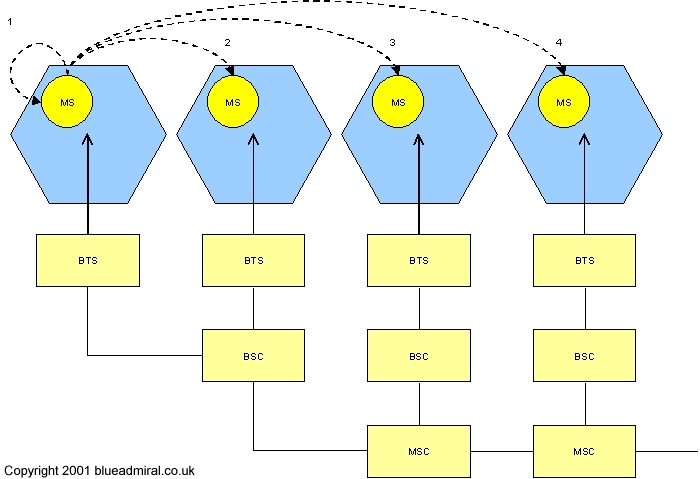 Figure 11 Types of handover within a GSM system